Launch & plan upgrade

context

context

context

Docs is a collaborative documentation feature that allows customers at awork organize, and edit content directly inside their workspace. Instead of relying on external tools like Notion. Helping teams centralize information and reduce fragmentation across tools.
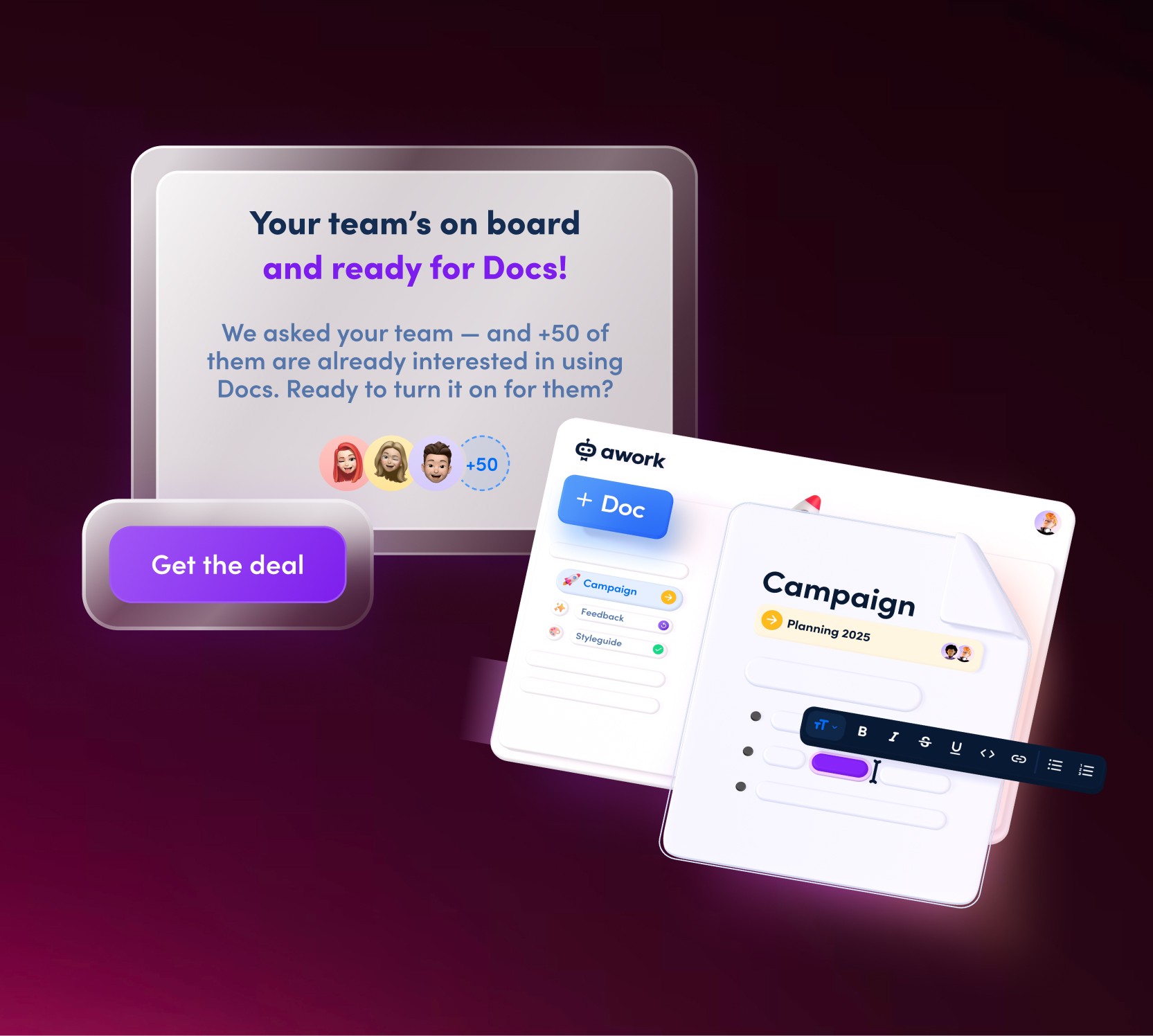
A collaborative documentation feature — similar to Notion-style pages, tightly integrated into existing project workflows.

A collaborative documentation feature — similar to Notion-style pages, tightly integrated into existing project workflows.

A collaborative documentation feature — similar to Notion-style pages, tightly integrated into existing project workflows.

A collaborative documentation feature — similar to Notion-style pages, tightly integrated into existing project workflows.

problem

problem

problem

Access was restricted to users only on the new Professional plan.

 Existing customers could not meaningfully use Docs unless they upgraded. This created a high-risk moment in the user experience:

 » A major new feature » A forced plan decision » No experiential context » Only Admins could upgrade plans, creating a decision bottleneck

Access was restricted to users only on the new Professional plan.

 Existing customers could not meaningfully use Docs unless they upgraded. This created a high-risk moment in the user experience:

 » A major new feature » A forced plan decision » No experiential context » Only Admins could upgrade plans, creating a decision bottleneck

Access was restricted to users only on the new Professional plan.

 Existing customers could not meaningfully use Docs unless they upgraded. This created a high-risk moment in the user experience:

 » A major new feature » A forced plan decision » No experiential context » Only Admins could upgrade plans, creating a decision bottleneck

solution

solution

solution

If users can integrate Docs into their real workflows for a limited time, they will understand its value through experience — reducing loss aversion and increasing confidence to upgrade. Intro access via a product-led trial: » 4-week full access to Docs for all users » Weeks 1–2: 50% upgrade incentive » Weeks 3–4: 15% incentive as urgency increased Discounts framed as supportive, not the value prop.

If users can integrate Docs into their real workflows for a limited time, they will understand its value through experience — reducing loss aversion and increasing confidence to upgrade. Intro access via a product-led trial: » 4-week full access to Docs for all users » Weeks 1–2: 50% upgrade incentive » Weeks 3–4: 15% incentive as urgency increased Discounts framed as supportive, not the value prop.

If users can integrate Docs into their real workflows for a limited time, they will understand its value through experience — reducing loss aversion and increasing confidence to upgrade. Intro access via a product-led trial: » 4-week full access to Docs for all users » Weeks 1–2: 50% upgrade incentive » Weeks 3–4: 15% incentive as urgency increased Discounts framed as supportive, not the value prop.

Goals

  • 256 account upgrades

  • Reduce the median time for new accounts to reach an upgrade-ready state from 18 days to 12 days.

Results

  • 🟠 207 account upgrades [87% of target achieved by Week 6]

  • 🟠 Reduced median time-to-upgrade-readiness to 13days

Key learnings

01.

Users don't upgrade based on features — they upgrade based on habits they've already formed.

02.

Transparency and reversibility reduce fear more than persuasion.

03.

Clear deadlines outperformed aggressive messaging.

04.

Individual Contributors decide with habits; Admins decide with confidence

Key learnings

01.

Users don't upgrade based on features — they upgrade based on habits they've already formed.

02.

Transparency and reversibility reduce fear more than persuasion.

03.

Clear deadlines outperformed aggressive messaging.

04.

Individual Contributors decide with habits; Admins decide with confidence

Key learnings

01.

Users don't upgrade based on features — they upgrade based on habits they've already formed.

02.

Transparency and reversibility reduce fear more than persuasion.

03.

Clear deadlines outperformed aggressive messaging.

04.

Individual Contributors decide with habits; Admins decide with confidence

Key learnings

01.

Users don't upgrade based on features — they upgrade based on habits they've already formed.

02.

Transparency and reversibility reduce fear more than persuasion.

03.

Clear deadlines outperformed aggressive messaging.

04.

Individual Contributors decide with habits; Admins decide with confidence

solution

If awork AI is introduced at moments of highest user intent and powered by pre-filled, context-aware prompts—users can engage instantly, reach value faster, and build a habit of returning to the feature organically. High-intent moments » Within a project: surface prompts to identify blockers, generate summaries, or assess project status. » Within time tracking: offer prompts such as Weekly Time Report or Missing Time Check to support quick, task-driven insights.

.say hello

Feel free to email me to see how can we collaborate

.say hello

Feel free to email me to see how can we collaborate